
A Simple Guide to the Flavors Hiding in Your Cup
The first time someone tells you a coffee tastes like blueberries, your reaction might be something like mine was:
Really?
It’s coffee.
Coffee tastes like...coffee.
Then you begin drinking coffees from different farms, regions, and countries. You try a bright Ethiopian coffee beside a rich Guatemalan. You notice that one reminds you of citrus while another seems sweeter and more chocolatey. Eventually, you encounter one of those coffees where the fruit flavor is so obvious that you stop for a second and wonder:
How did that get in there?
It’s a great question.
If the bag says blueberry, peach, chocolate, brown sugar, citrus, or honey, did someone actually put those things into the coffee?
Usually, no.
Those words are tasting notes—our attempt to describe flavors and aromas that naturally remind us of other things we already know.
And learning to recognize them is one of the most enjoyable parts of exploring specialty coffee.
Coffee Is More Complicated Than It Looks
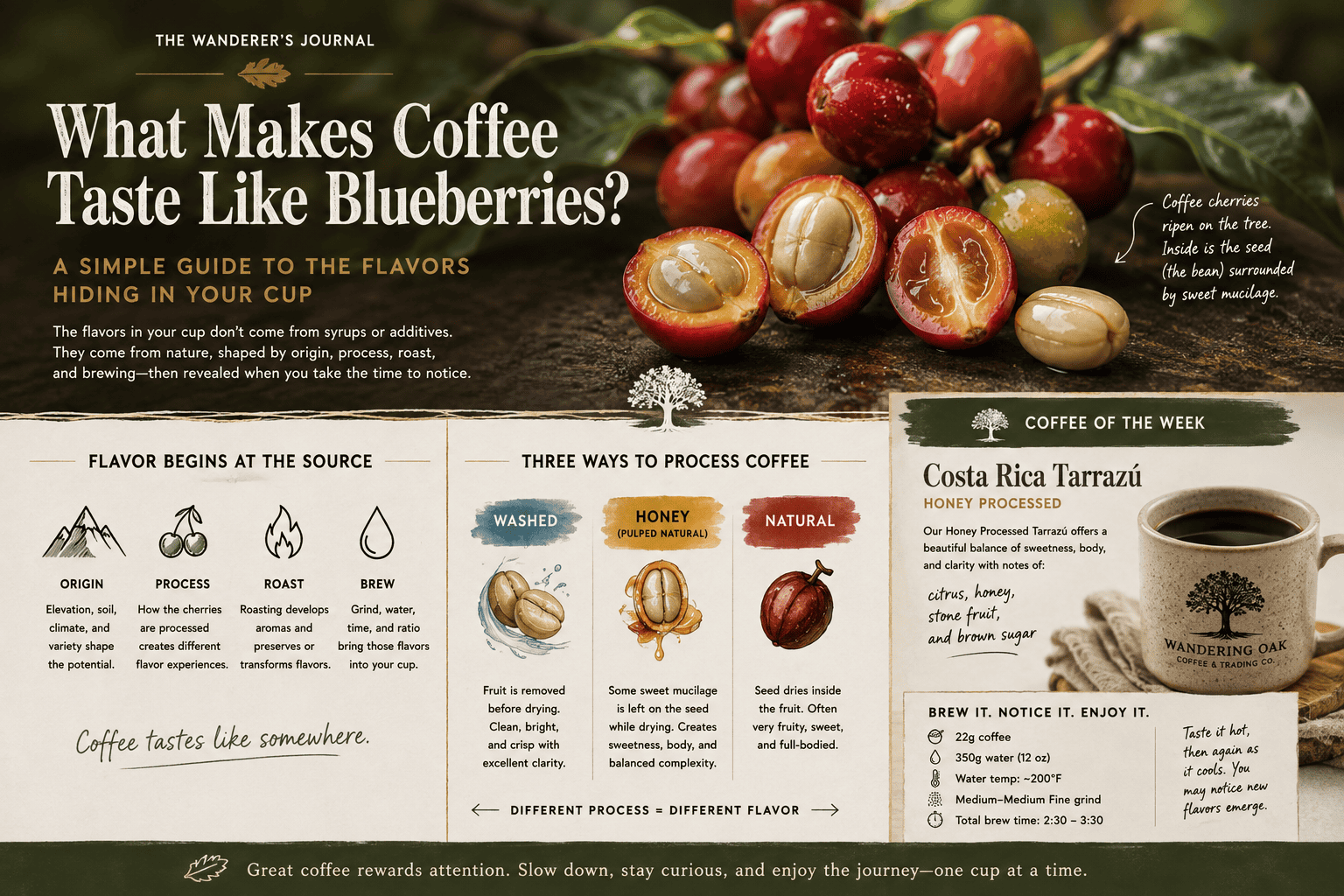
We tend to think of coffee as a bean, but what we call a coffee bean is actually the seed of a fruit.
Coffee grows on trees as small fruits commonly called coffee cherries. As those cherries ripen, they develop sugars and complex compounds that ultimately influence what we experience in the cup. Inside the fruit are the seeds that will eventually be processed, dried, roasted, ground, and brewed as coffee.
That means the flavor in your morning cup begins developing long before the coffee ever reaches a roaster.
Where the coffee was grown matters. The elevation matters. The climate matters. The variety of coffee matters. The ripeness of the cherries matters. How the farmer processes and dries the coffee matters.
Then the roaster gets involved.
Roasting transforms the coffee chemically and develops hundreds of aromatic compounds. Roast too aggressively and some of the more delicate characteristics of the coffee can disappear beneath darker roast flavors. Roast thoughtfully, particularly with a beautiful light- or medium-roast coffee, and many of those distinctive characteristics can remain wonderfully expressive.
Finally, you brew it.
Your grind, water, temperature, ratio, and brewing method determine how successfully you extract those flavors into your cup.
So when you take a sip of coffee, you’re experiencing the result of an extraordinary chain of decisions stretching from a coffee tree somewhere around the world all the way to your kitchen.
There is a lot of story hiding in a little brown bean.
But Where Does “Blueberry” Come From?
When we describe a coffee as having a blueberry note, we aren’t saying it contains blueberries. We’re saying something in the coffee’s combination of aroma, sweetness, acidity, and flavor reminds us of blueberry.
Think about chocolate for a moment.
Chocolate can be dark, sweet, bitter, fruity, nutty, creamy, or earthy. Wine can remind people of cherries, blackberries, vanilla, tobacco, or spices even though none of those ingredients were necessarily added to it.
Coffee works similarly.
Our brains are remarkably good at connecting new sensory experiences with flavors and aromas we already recognize.
You might taste a coffee and think, That reminds me of orange.
Someone else might call it citrus.
Another person may say tangerine.
Nobody necessarily has to be wrong. You're trying to find familiar language for a complicated sensory experience.
That’s why I don't want tasting notes to become a test.
If a bag says peach and you don't taste peach, you haven't failed at drinking coffee.
Maybe you taste honey.
Maybe you taste lemon.
Maybe you simply think, That's really good.
That counts.
Origin Changes the Cup
This is where coffee gets fascinating.
Coffee grown in different parts of the world can develop dramatically different characteristics.
Some Ethiopian coffees are famous for floral, citrus, berry, and stone-fruit qualities. Kenyan coffees can be wonderfully bright and juicy. Central American coffees often give us beautiful combinations of chocolate, caramel, nuts, citrus, and fruit.
Even two farms located relatively close together can produce noticeably different coffees because of differences in elevation, coffee variety, soil, microclimate, agricultural practices, and processing.
In the coffee world, you'll sometimes hear the word terroir used to describe this idea—the influence of place on agricultural products.
I prefer a simpler way of saying it:
Coffee tastes like somewhere.
That is one of the reasons I love single-origin coffees. They give us an opportunity to experience a particular place through the cup.
Processing Changes the Story
Once coffee cherries are harvested, the producer has to separate and dry the seeds. How that happens can dramatically affect flavor.
In a washed process, much of the fruit is removed before the coffee is dried. These coffees often showcase clarity and the inherent character of the bean beautifully.
In a natural process, the coffee seed dries inside the fruit. That prolonged contact can contribute intense fruitiness, sweetness, and sometimes those wonderful berry-like characteristics people associate with certain coffees.
And then there is the honey process.
Despite the name, no honey needs to be added.
Instead, some of the sticky fruit material—called mucilage—is intentionally left around the coffee seed while it dries. That can create a beautiful middle ground between washed and natural processing, often producing a cup with noticeable sweetness, body, fruit character, and clarity.
Which brings us to this week's coffee.
Coffee of the Week
Costa Rica Tarrazú — Honey Process
Costa Rica's Tarrazú region produces some beautiful coffees, and our honey-processed Tarrazú is a wonderful coffee for beginning to explore how processing and origin influence flavor.
The name honey process can be confusing at first. The coffee hasn't simply been soaked in honey. Rather, some of the naturally sweet mucilage surrounding the coffee seed remains during drying. That process can contribute additional sweetness and complexity to the finished cup.
This is exactly the kind of coffee I'd encourage you to slow down with.
If you have a pour-over brewer, use the basic recipe from our last Journal entry: about 22 grams of coffee to 350 grams of water, with water around 200°F. Start with a medium to medium-fine grind and adjust from there according to taste.
Then don't drink it all immediately.
Taste it hot.
Give it a few minutes.
Taste it warm.
Try it again as it gets closer to room temperature.
You may notice that the cup changes. Sweetness can become easier to perceive, and flavors that were difficult to identify when the coffee was piping hot may suddenly become much clearer.
That's when coffee tasting gets fun.
You're no longer asking:
Does this taste exactly like the words printed on the bag?
You're asking:
What do I notice?
And that's a much better question.
Learning to Taste Without Becoming a Coffee Snob
There is an unfortunate tendency in specialty coffee to make something wonderfully enjoyable seem unnecessarily intimidating.
I don't want to do that.
You don't need an advanced palate. You don't need to memorize a flavor wheel. You certainly don't need to pretend you taste bergamot, elderflower, or some obscure tropical fruit you've never actually eaten.
Start with broad categories.
Is it sweet?
Is it fruity?
Does it remind you of chocolate?
Something nutty?
Something citrusy?
Does it feel bright and lively, or rich and comforting?
Once you start noticing those larger characteristics, you can become more specific over time.
The point isn't to become impressive at describing coffee.
The point is to become better at enjoying it.
And that's really what we're trying to do at Wandering Oak.
We want to teach coffee without taking the joy out of it. We want you to understand enough about what is happening in your cup that you become curious about the next one.
Try Costa Rica.
Then Ethiopia.
Then Guatemala.
Then Kenya.
Taste them side by side sometime.
Pay attention to what changes.
You may eventually find blueberries.
But even if you don't, you'll probably discover something else worth noticing.
Field Note
Try this simple experiment.
Take a sip of your coffee and don't immediately try to identify a flavor. Instead, ask three questions:
Is it sweet?
Is it bright or rich?
What familiar food or aroma does it remind me of?
There are no wrong answers.
Write down the first thing that comes to mind. Then taste the coffee again ten minutes later and see whether your answer changes.
Around the Fire
The next time you're sharing coffee with someone, don't tell them the tasting notes first.
Pour the coffee and ask:
“What does this remind you of?”
You may be surprised how differently two people experience exactly the same cup.
And that's part of the fun.
Until next time...
Grow Deep.
Wander Well.
Gather Generously.
...and drink good coffee.
— Chad Mason